Xiaomi BE3600 Black Edition (RD16) Teardown: MediaTek Platform & Impressive 5GHz Range

- I. Accessories, Ports & Power Consumption
- II. Teardown & Thermal Architecture
- III. Detailed Silicon & Hardware Architecture
- 1. Main Processor (CPU / SoC)
- 2. DRAM Memory
- 3. Flash Storage
- 4. Wi-Fi Baseband & MAC Controller
- 5. RF Transceiver
- IV. Real-World Speed Testing & Fast Roaming
- V. Verdict & Buying Advice
Following the release of the Qualcomm-powered white version, Xiaomi released a new Black Edition of the BE3600, designated under product model RD16.
While it carries the identical BE3600 commercial badge, the internals are entirely different: Xiaomi replaced the entire Qualcomm platform with a MediaTek / Airoha chipset, omitted the 2.5GbE port, and fitted four standard Gigabit Ethernet ports.
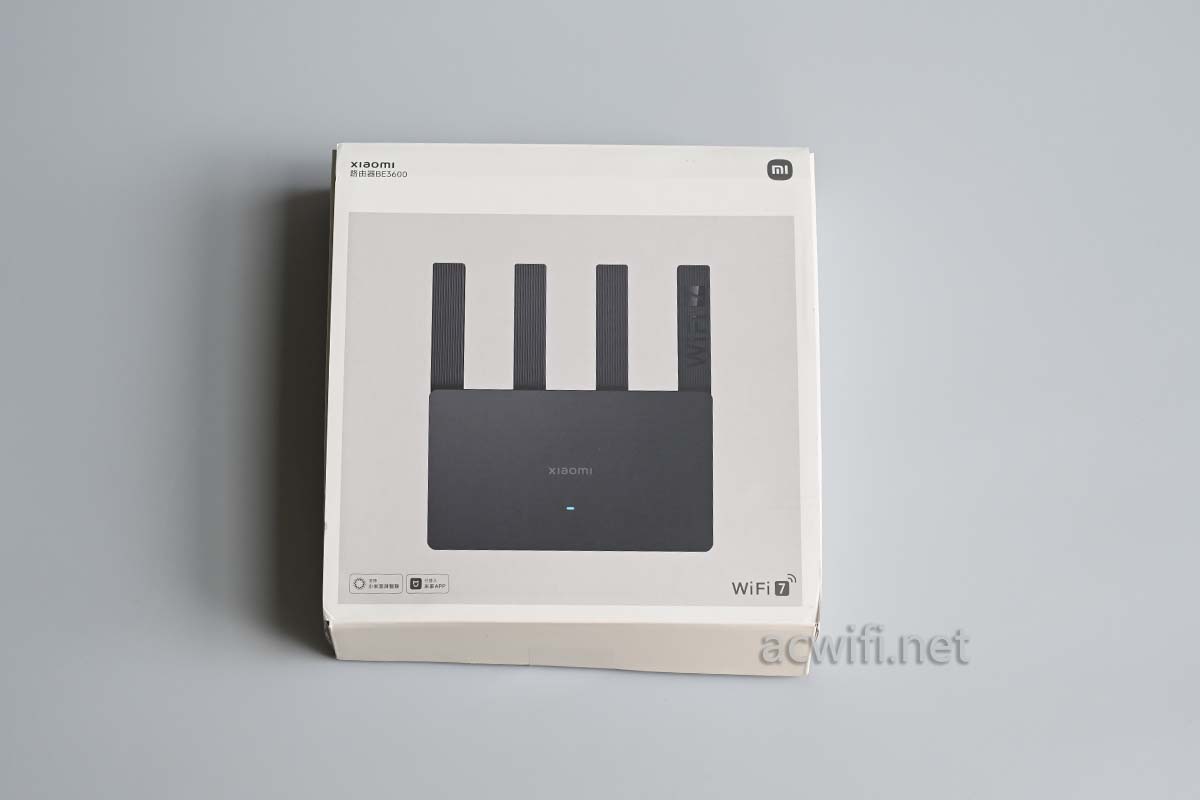
Let’s tear down the Xiaomi BE3600 Black Edition to inspect the board components and real-world RF performance.
I. Accessories, Ports & Power Consumption
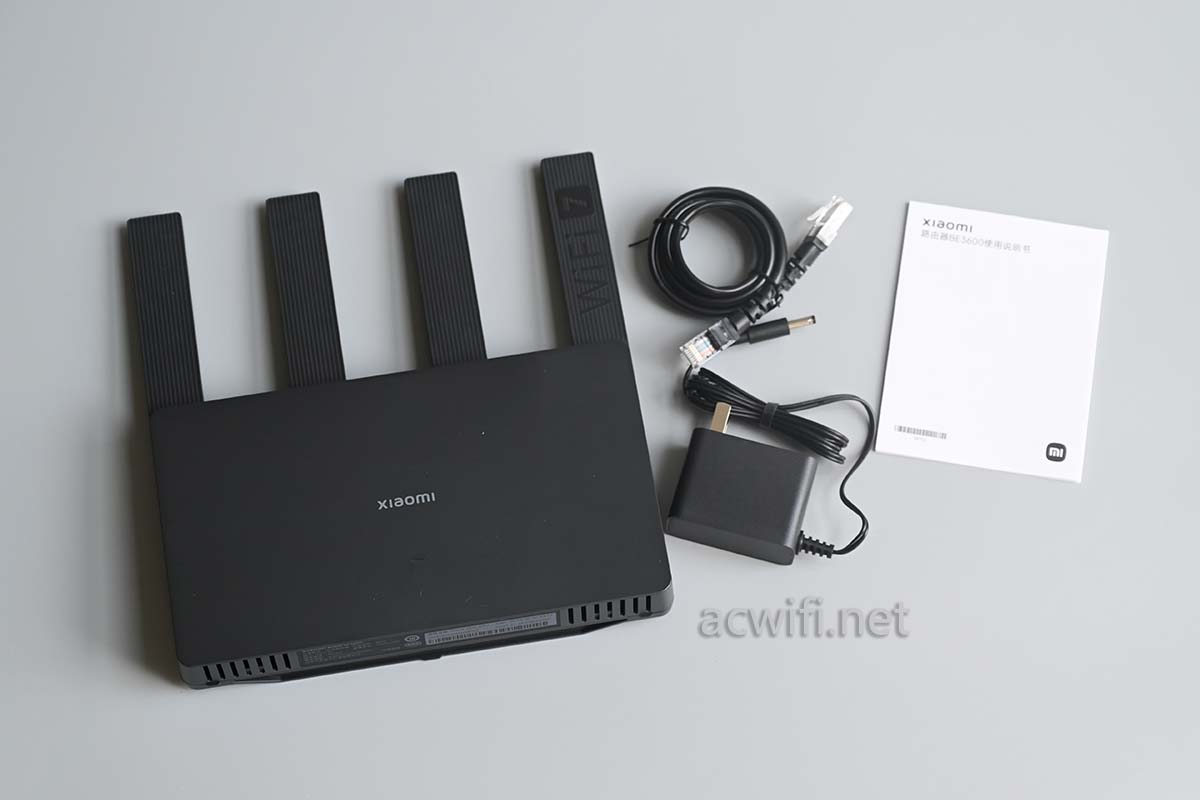
The package includes the black router unit, a DC power adapter, and an Ethernet patch cable:
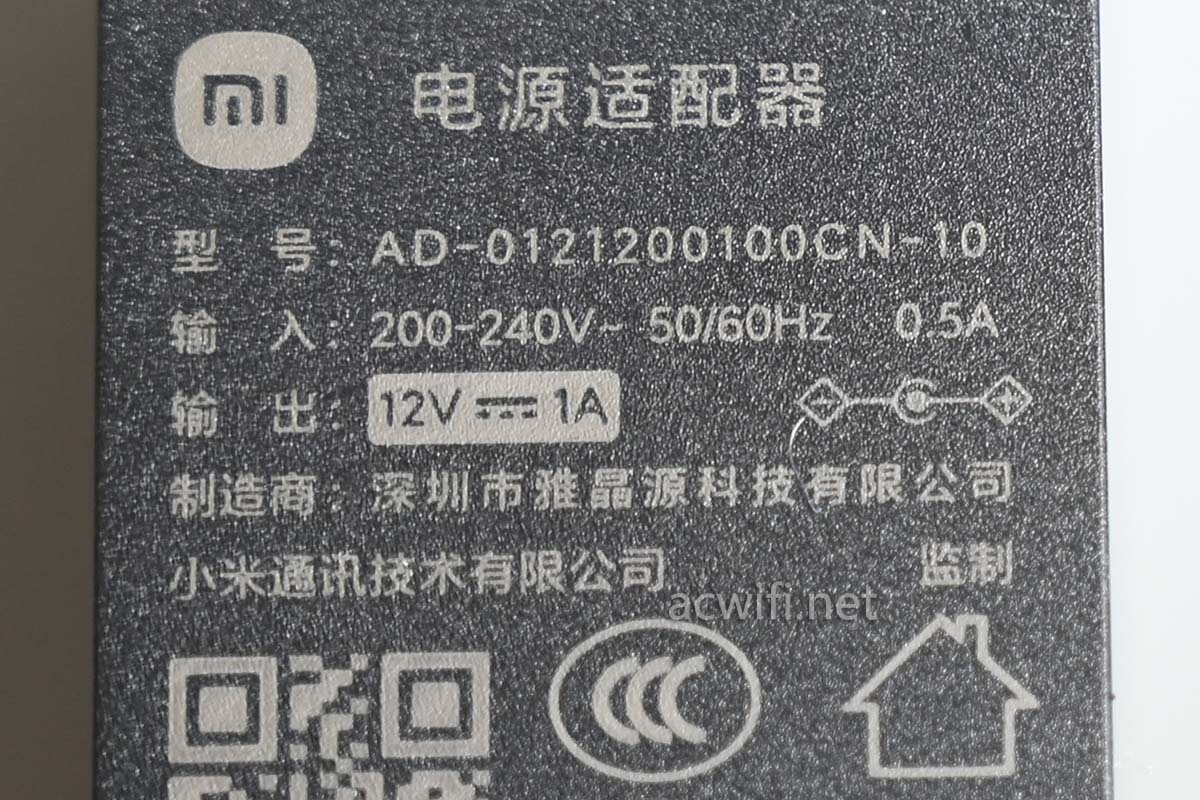
The bundled power adapter is rated at 12V / 1A (lower than the 1.25A / 1.5A bundled with the white models):
Wall power meter measurements:
- Idle standby (no network cable attached): Consumes just 4.4W.
- Connected to 1Gbps WAN: Power draw only rises to 4.7W.
The 4.4W – 4.7W power draw is remarkably low—noticeably lower than the ~6.4W – 7.9W of the white Qualcomm edition. This MediaTek architecture is extremely power-efficient and runs very cool.
The chassis shares the same external form factor as the white edition, finished in an understated matte black coat:
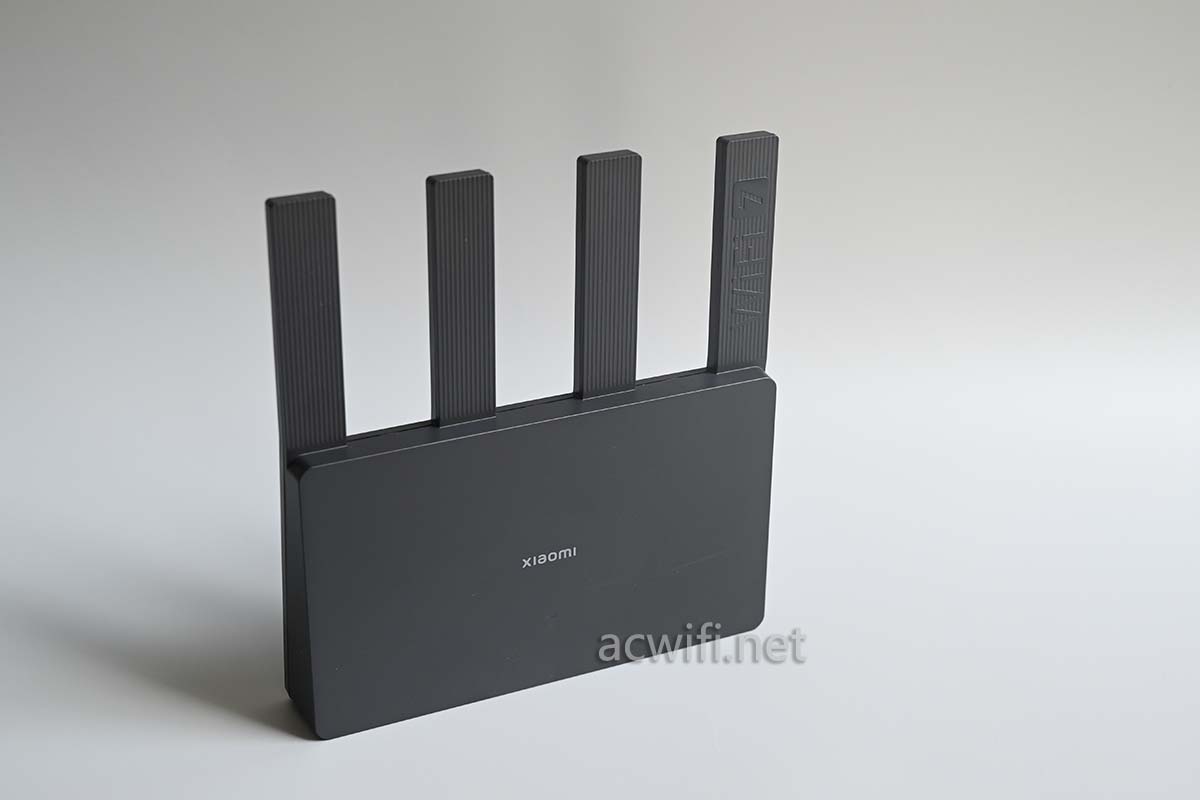
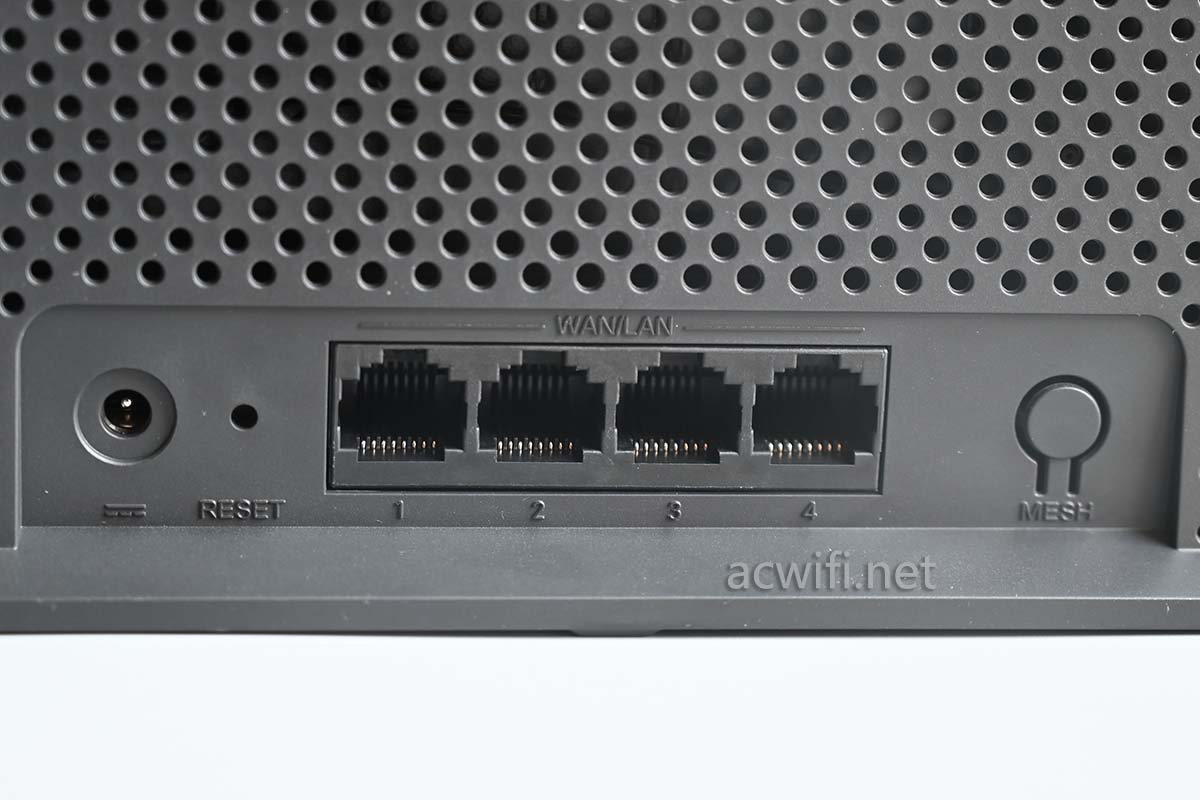
Important buyer caveat: The Black BE3600 (RD16) features four Gigabit Ethernet ports. It DOES NOT have a 2.5GbE port like the white RD15 edition.
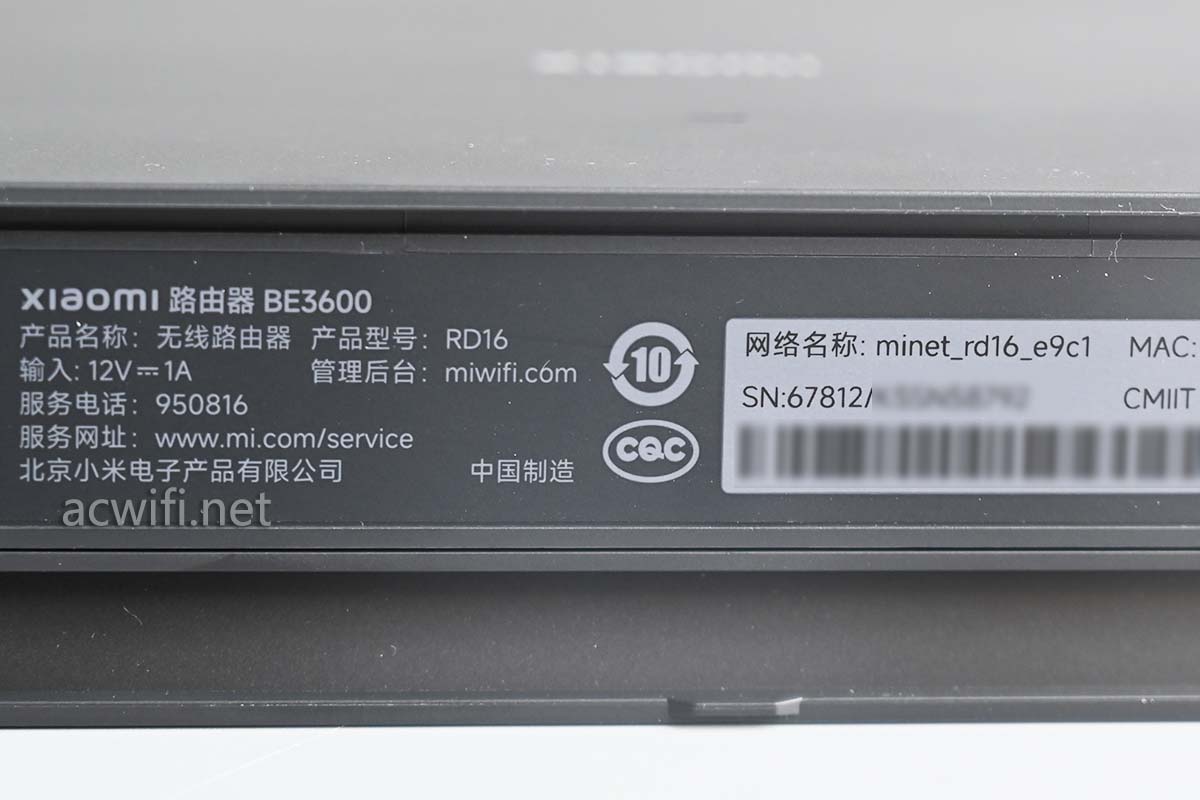
The bottom label confirms the product model is RD16:
II. Teardown & Thermal Architecture
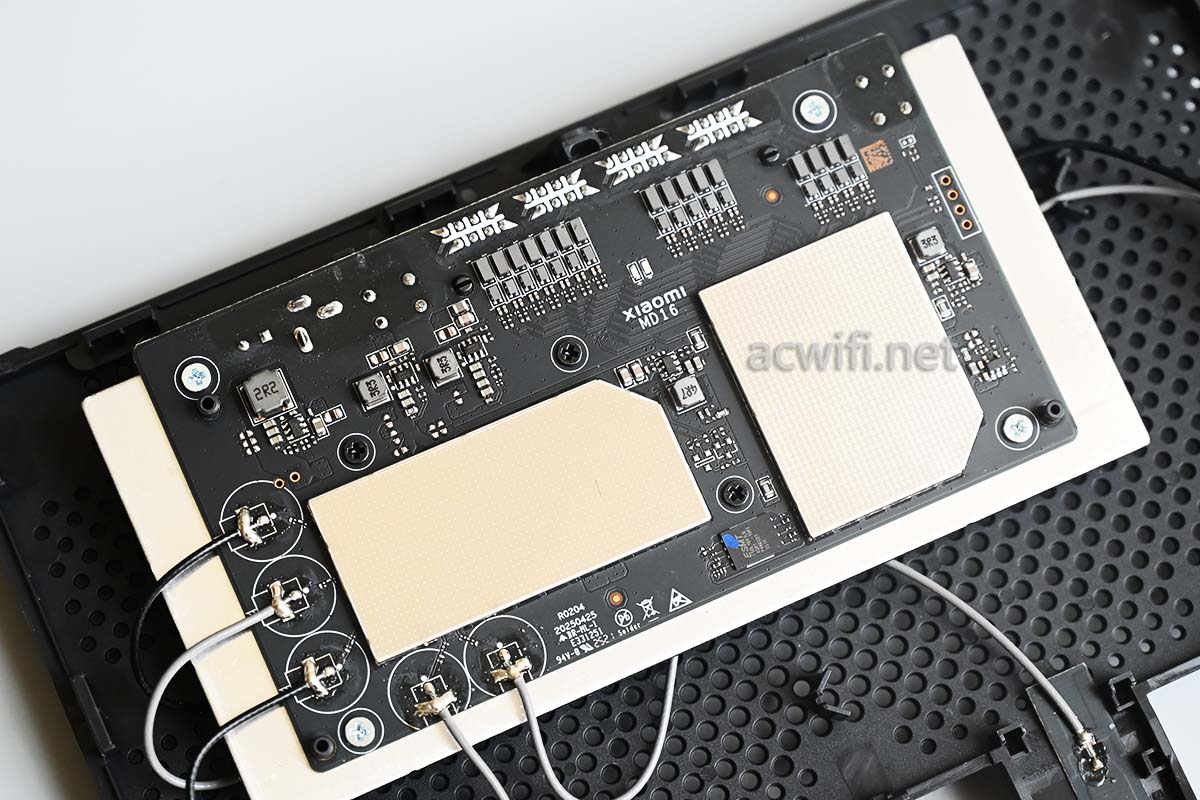
Prying open the lower shell reveals the internal PCB:
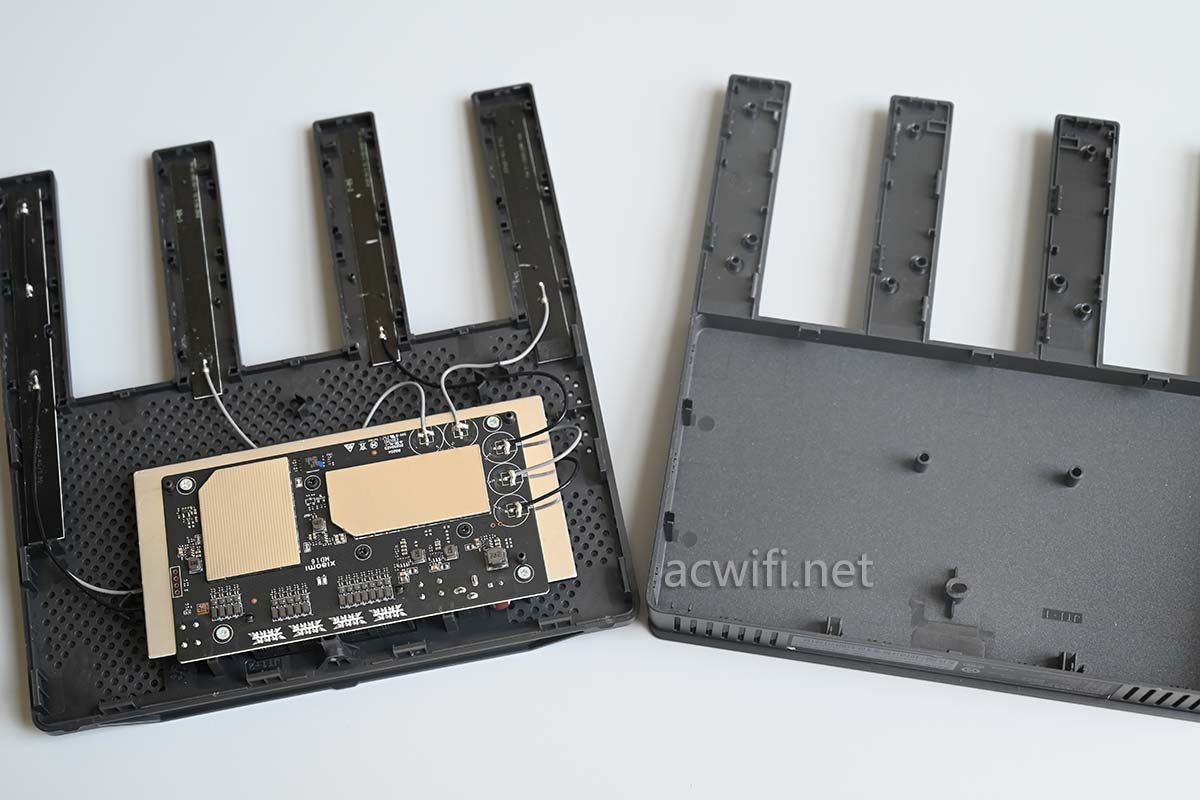
Examining the 5G antenna cable feeding layout reveals a distinctive MediaTek RF footprint:
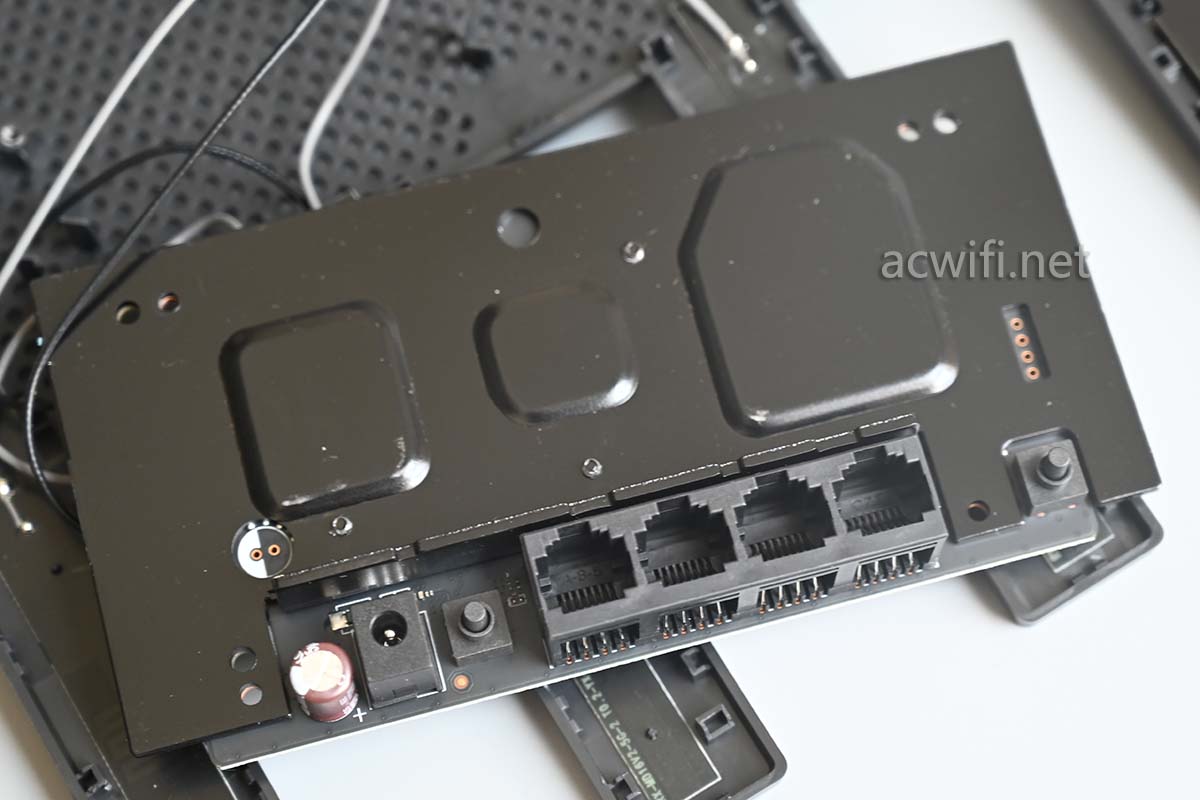
Flipping the board over reveals an oversized aluminum heatsink that spans wider than the motherboard itself:
Removing the heatsink plate:
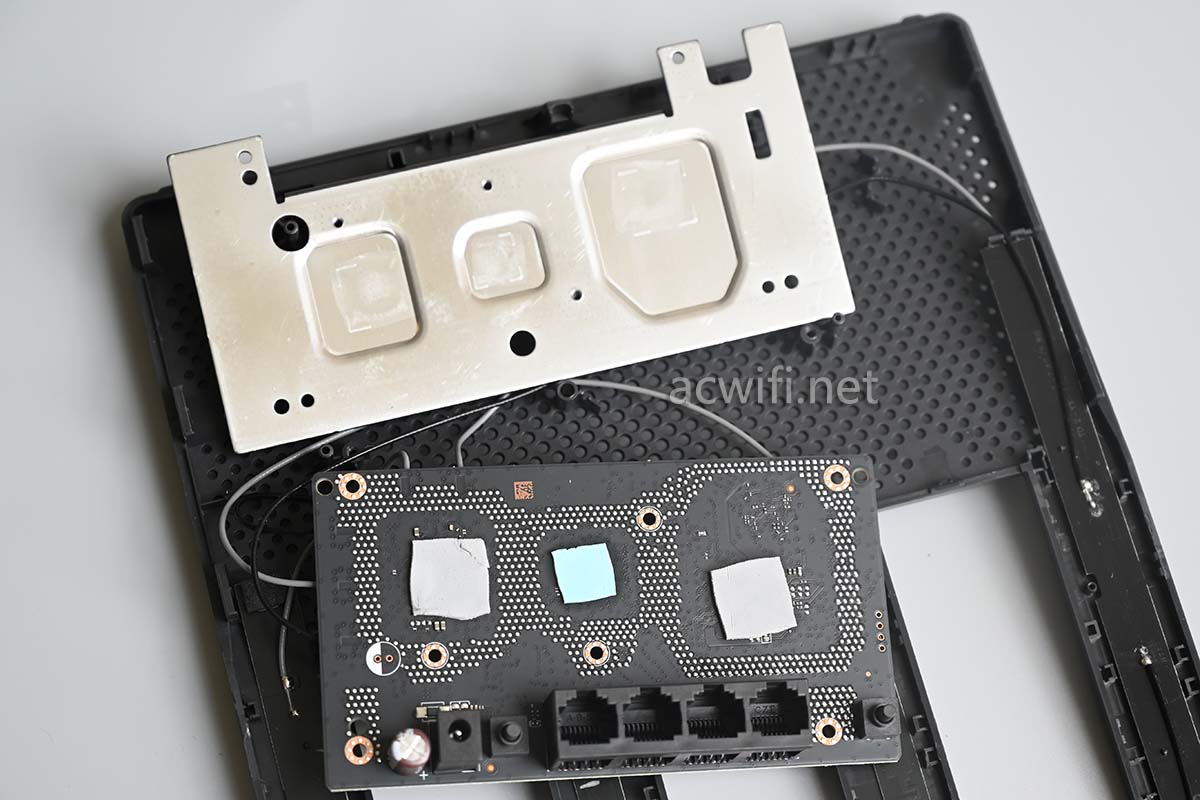
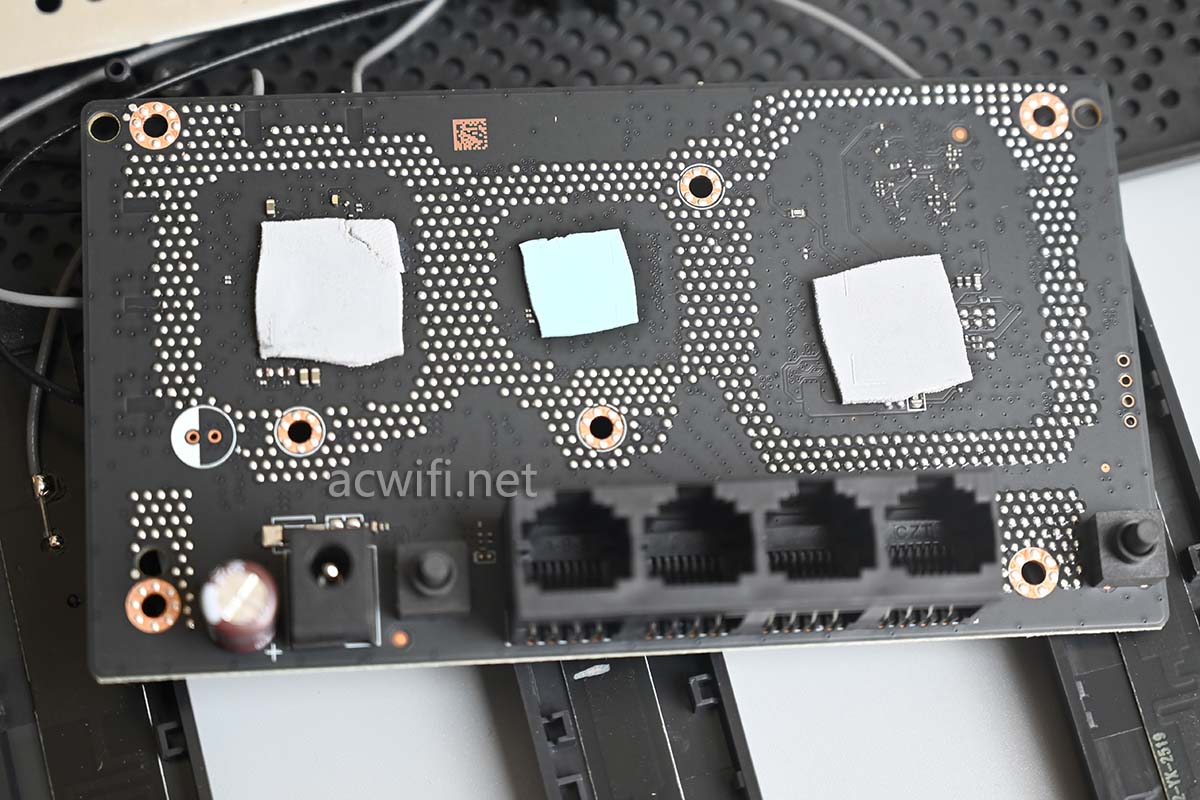
Three silicone thermal pads facilitate heat transfer directly from the PCB to the large aluminum plate:
Prying open the front metal shielding cans:
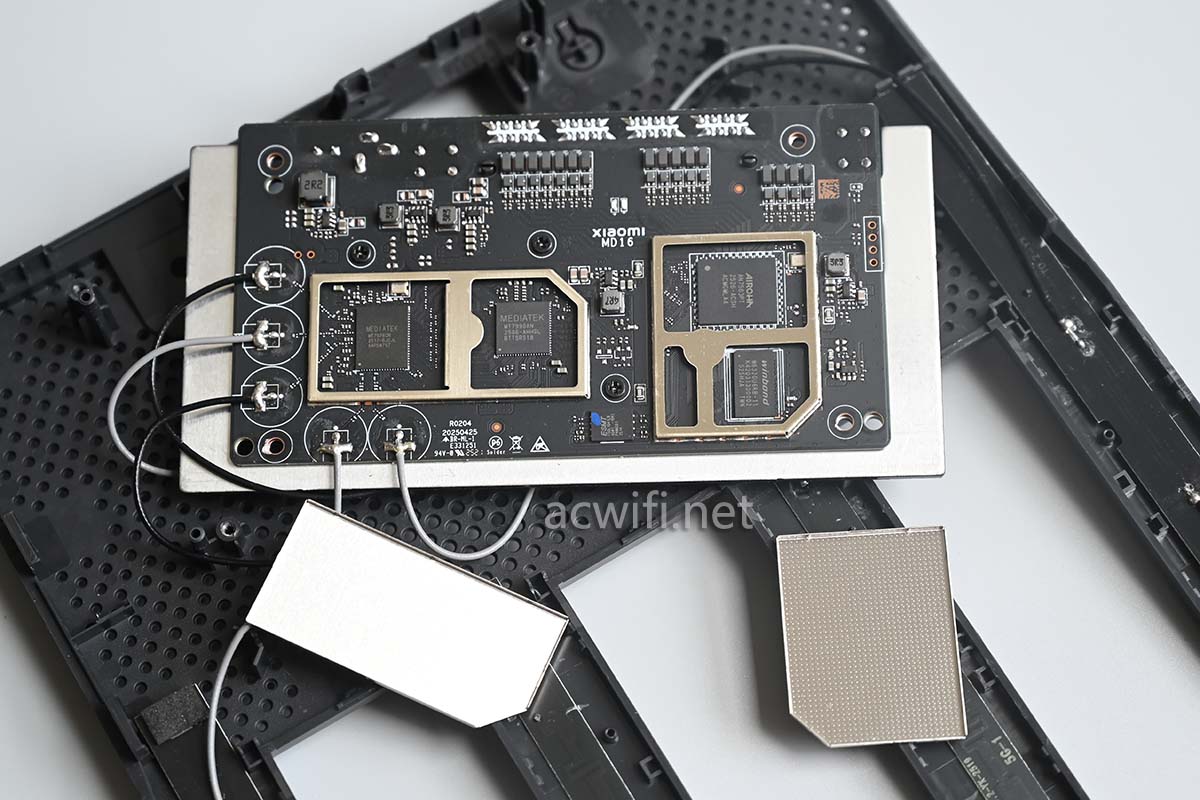
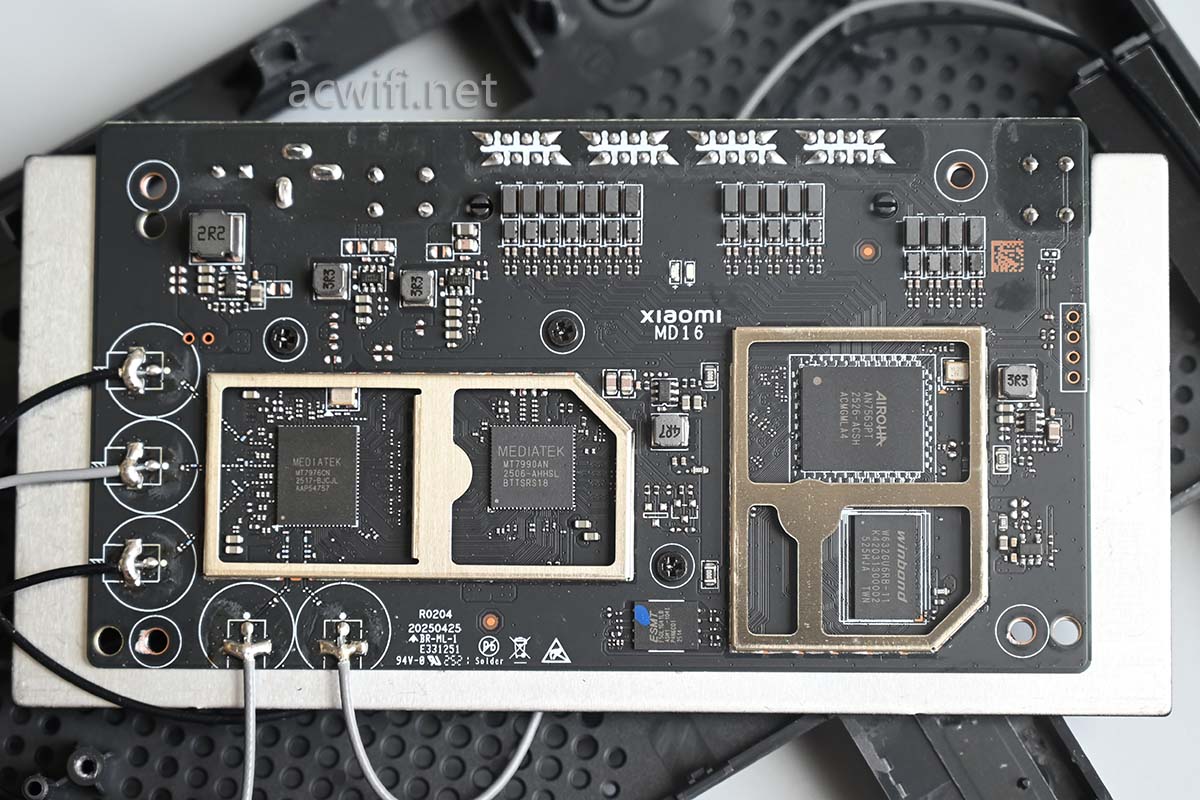
The core silicon ICs of the Xiaomi BE3600 RD16 are now fully exposed:
III. Detailed Silicon & Hardware Architecture
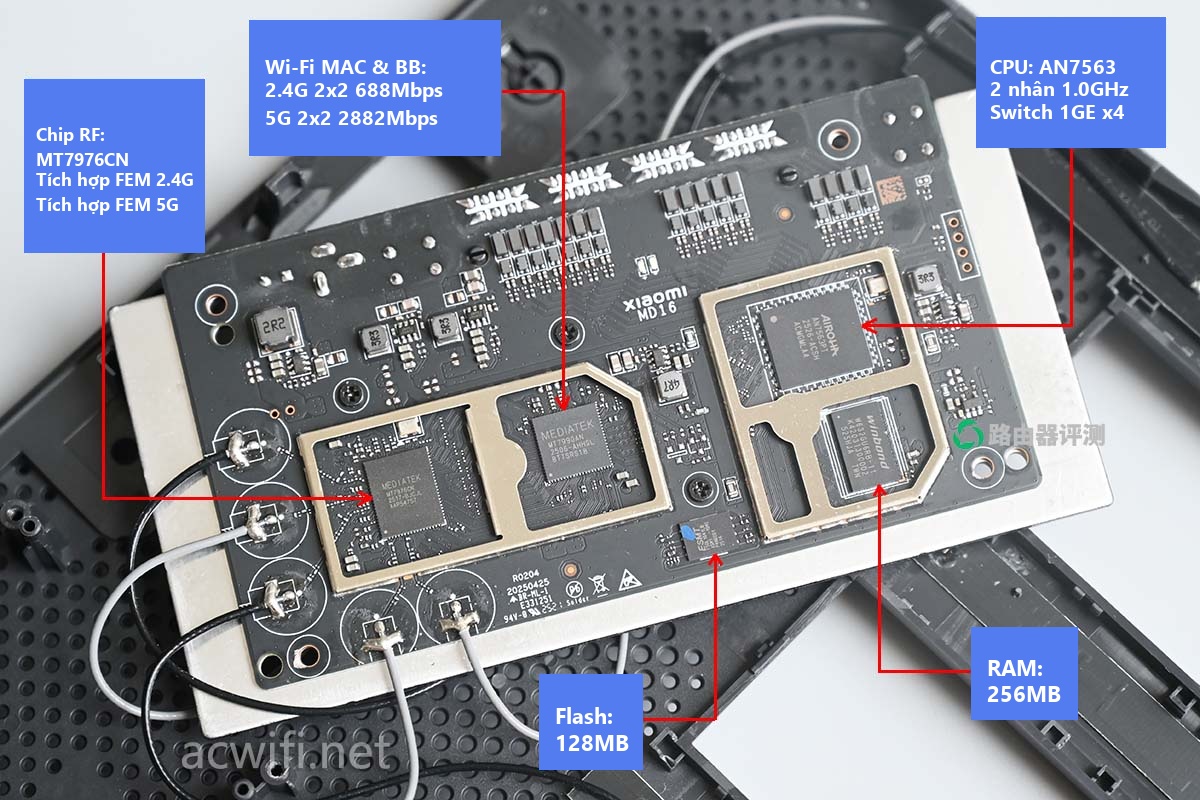
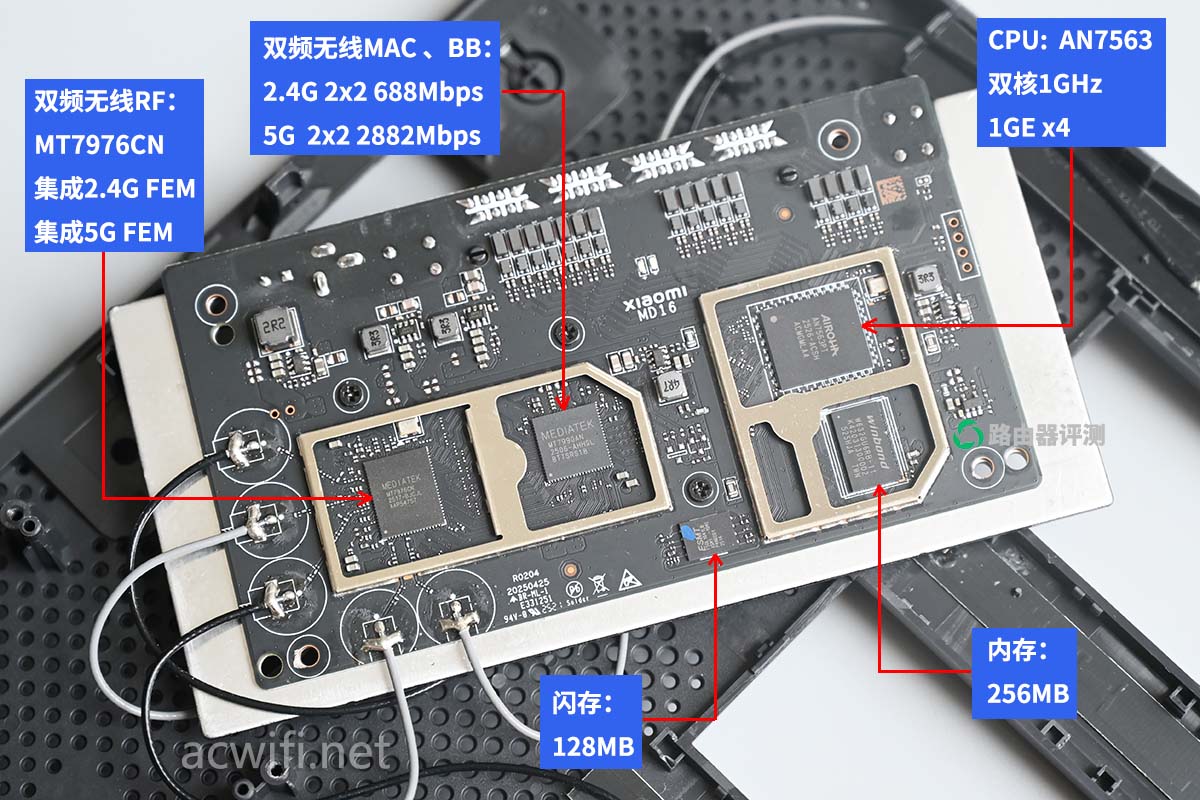
Every primary IC on this black revision belongs to the MediaTek / Airoha hardware ecosystem:
1. Main Processor (CPU / SoC)
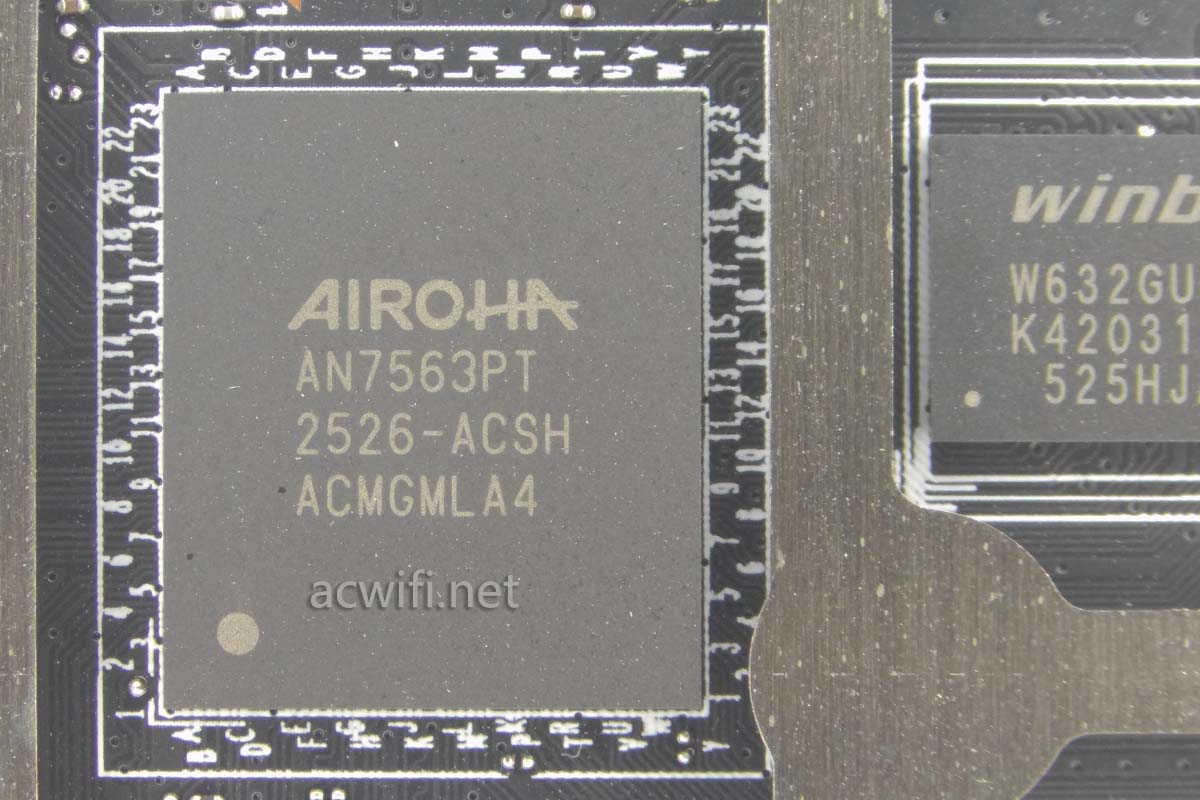
Powering the router is the Airoha AN7563PT (Airoha is MediaTek’s networking silicon subsidiary):
- Architecture: Dual-core ARM Cortex-A53 clocked at 1.0GHz.
- Integrated switch fabric managing all four Gigabit Ethernet ports (1GE x4).
2. DRAM Memory
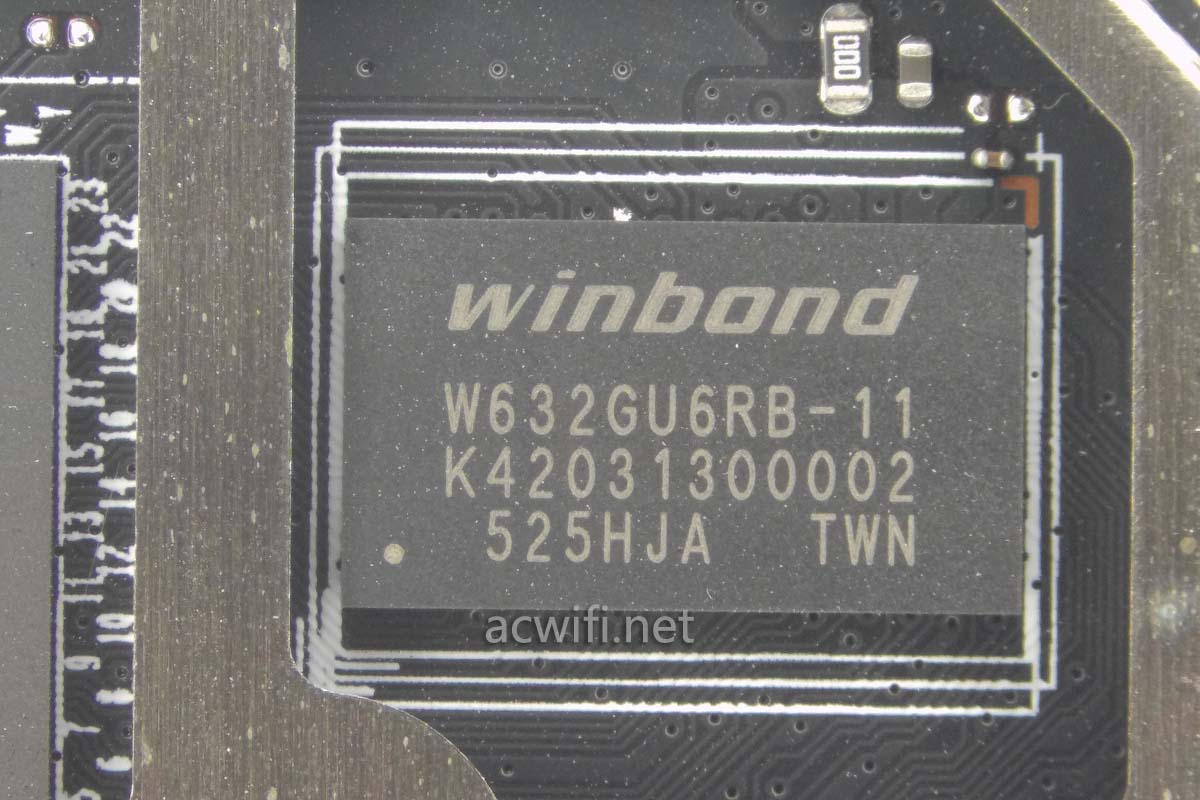
Directly adjacent to the SoC is a Winbond SDRAM chip with part number W632GU6RB-11:
- Standard: DDR3-1866
- Capacity: 256MB
3. Flash Storage
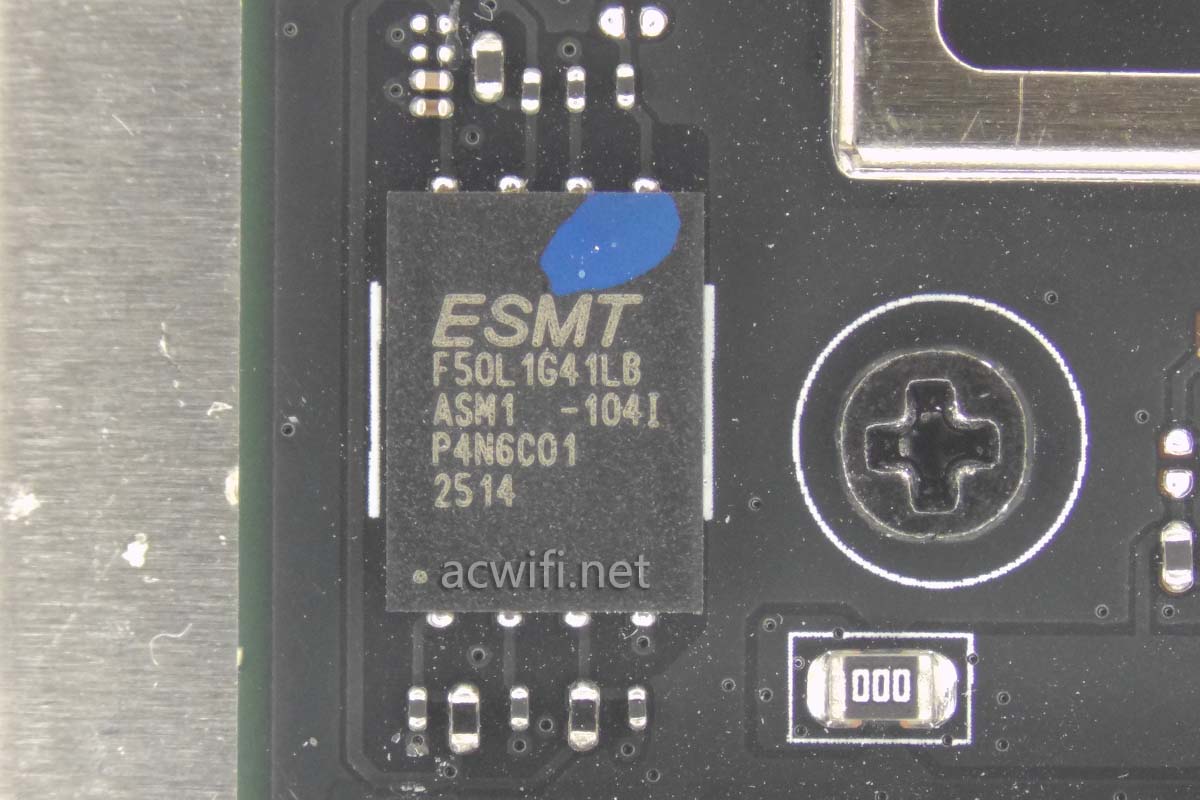
Firmware is stored on an ESMT (Elite Semiconductor Microelectronics Technology) F50L1G41LB 128MB SPI NAND flash chip:
4. Wi-Fi Baseband & MAC Controller
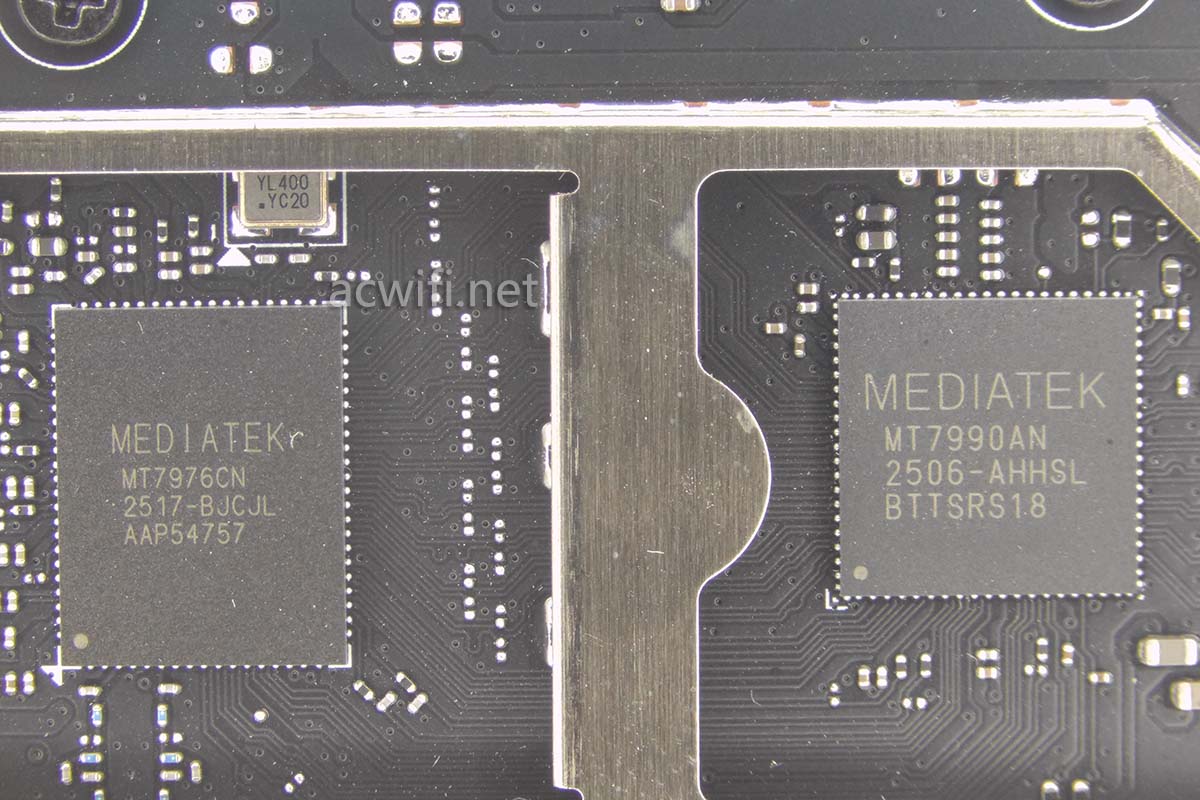
Baseband (BB) and MAC duties are handled by the MediaTek MT7990AN, delivering dual-band Wi-Fi 7:
- 2.4GHz Band: 2x2 MIMO, 40MHz channel width, 4096-QAM, theoretical maximum speed of 688 Mbps.
- 5GHz Band: 2x2 MIMO, 160MHz channel width, 4096-QAM, theoretical maximum speed of 2882 Mbps.
5. RF Transceiver
The radio frequency (RF) transceiver is the MediaTek MT7976CN:
- Supports 2T2R on 2.4GHz and 3T3R on 5GHz.
- Incorporates integrated front-end modules (iFEMs) for both bands directly within the chip, avoiding the need for discrete external FEMs.
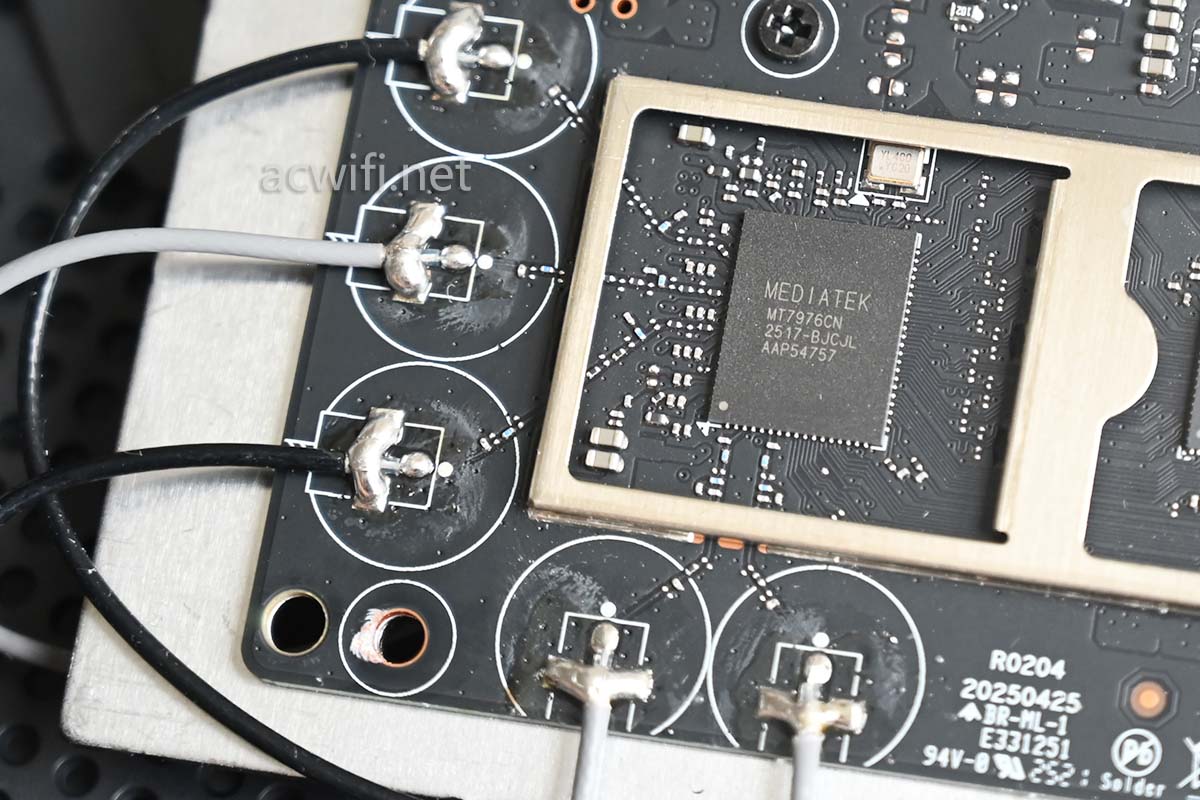
Close-up of the rear circuit board section:
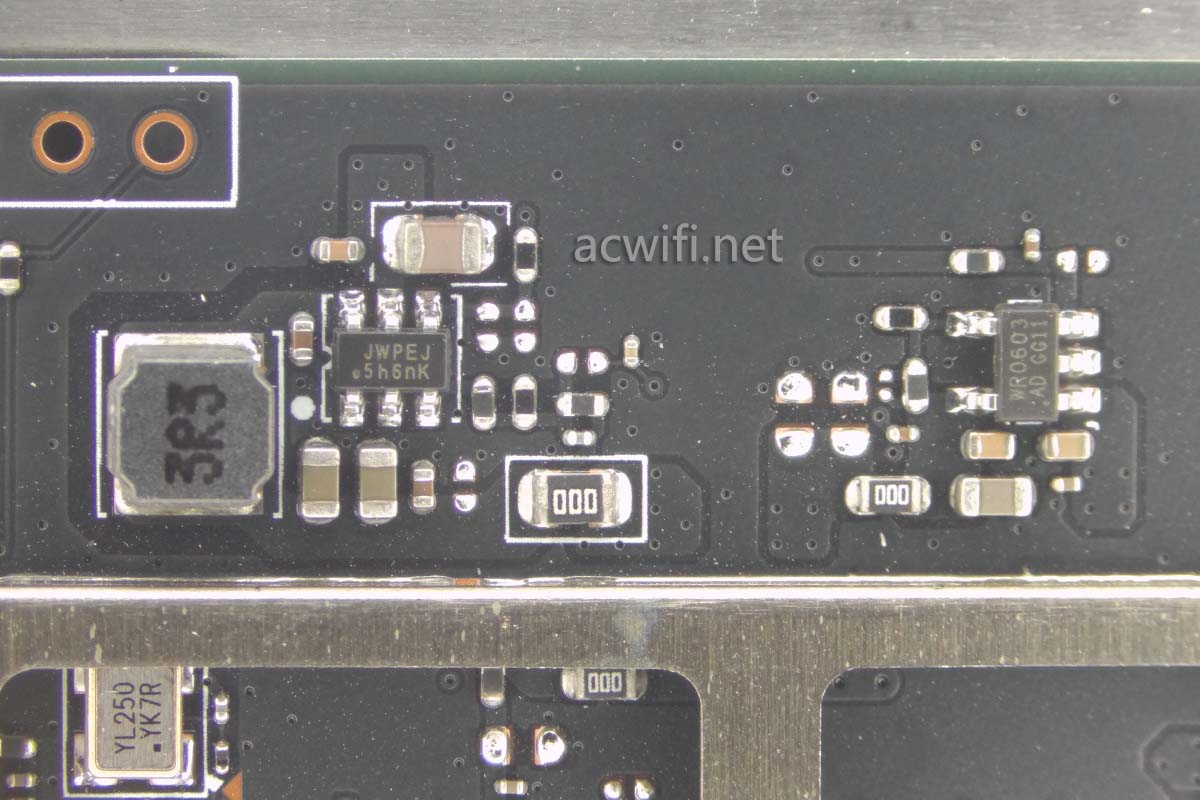
Complete component mapping for the Xiaomi BE3600 Black (RD16):
IV. Real-World Speed Testing & Fast Roaming
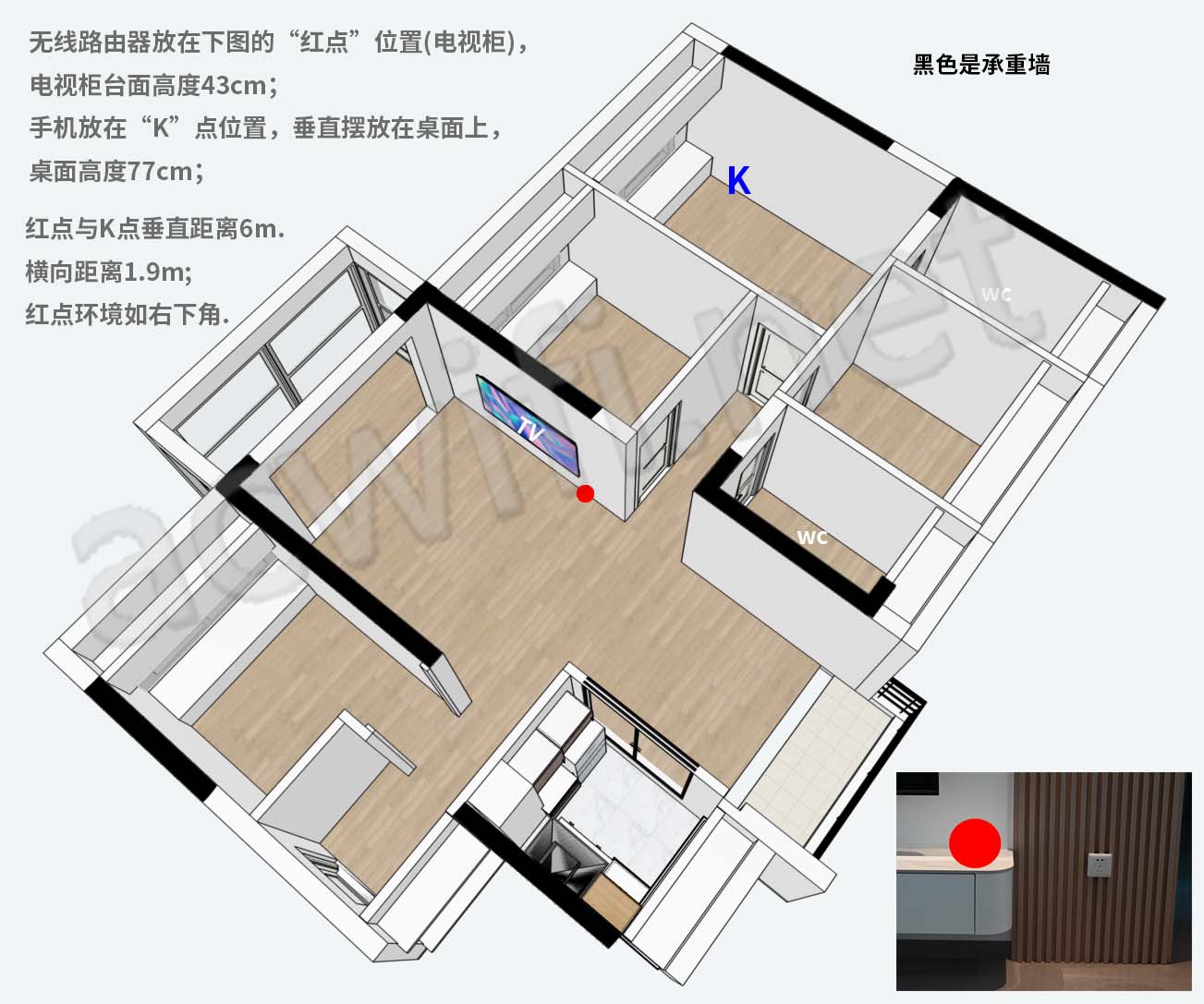
Wireless speed tests were conducted at Point K (a challenging location behind concrete walls):
Speed test results across five smartphones at Point K:
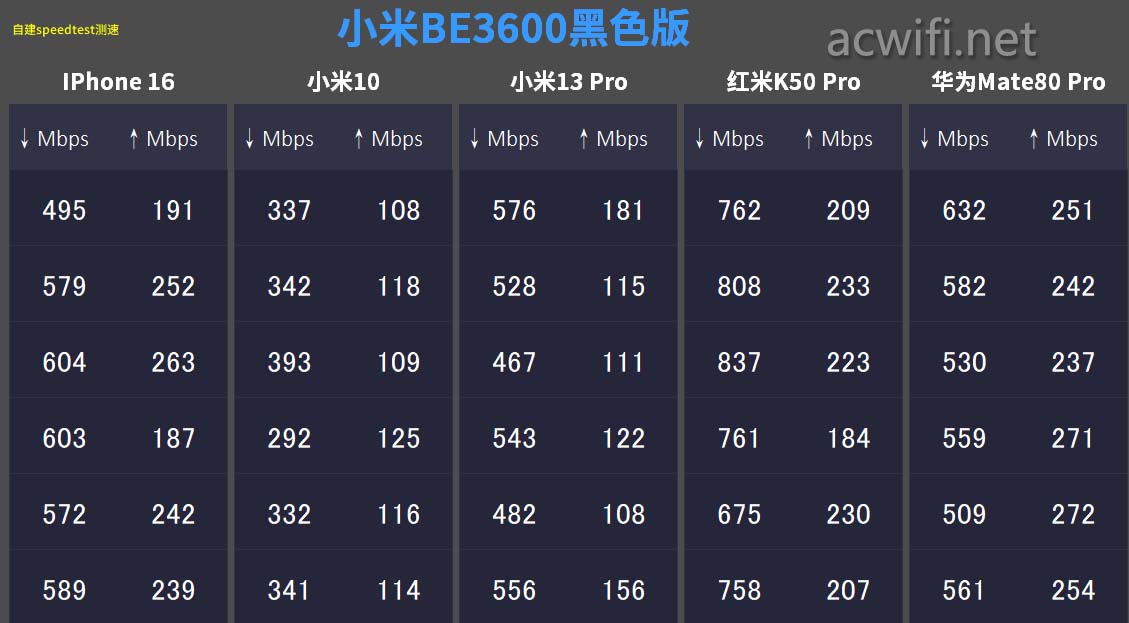
RF Performance Insight: Across all client smartphones at Point K, the black MediaTek version demonstrated noticeably higher 5GHz throughput through walls than the white Qualcomm edition.
This aligns with historical MediaTek Wi-Fi performance (dating back to Wi-Fi 6 AX3000): even with integrated FEMs, MediaTek’s 5GHz penetration and distance retention remain consistently outstanding.
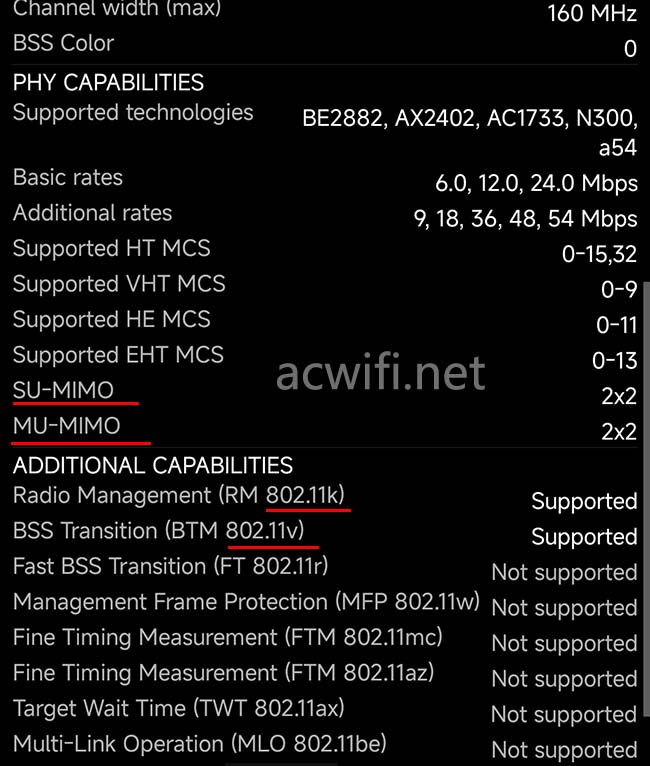
Fast Roaming protocol verification:
- Both 802.11k (RRM) and 802.11v (BSS-TM) are enabled out of the box.
- Beamforming and MU-MIMO are active by default:
V. Verdict & Buying Advice
Comparison between the two Xiaomi BE3600 variants:
| Feature | White Edition (RD15) | Black Edition (RD16) |
|---|---|---|
| SoC Platform | Qualcomm IPQ5312 (Quad-core A53 1.1GHz) | MediaTek / Airoha AN7563PT (Dual-core A53 1.0GHz) |
| Ethernet Ports | 1x 2.5GbE + 3x Gigabit | 4x Gigabit (No 2.5G port) |
| Wi-Fi Chipset | Qualcomm IPQ5312 + QCN6402 | MediaTek MT7990AN + MT7976CN |
| FEM Amplification | Discrete External FEMs (CanSemi KCT) | Integrated internal FEMs (iFEM inside MT7976CN) |
| Power Consumption | 6.0W – 7.9W (1.25A / 1.5A adapter) | 4.4W – 4.7W (1A adapter, highly efficient) |
| 5GHz Wall Penetration | Good | Superior |
Buying Advice:
- If your internet plan exceeds 1Gbps or you run a 2.5GbE local NAS, pick the White Edition (RD15) for its high-speed 2.5G port.
- If your broadband is 1Gbps or below and your primary priority is lower heat, lower electricity consumption, and stronger 5GHz wall penetration, the Black Edition (RD16) is a compelling choice.
Good luck with your setup!
If you have any questions or insights regarding Xiaomi Wi-Fi 7 routers, feel free to leave a comment below.
Original source: 小米BE3600黑色版拆机-路由器交流
Comments & Discussion
Share your thoughts, ask questions and feedback